CellAuto Safeguards China’s First Approved Stem-Cell Clinical Application for Type-2 Diabetes with a Fully-Automated, Compliant Manufacturing System
October 20, 2026CellAuto Drives Biomanufacturing Upgrade Through Production-Line Transformation, Advancing the National Intelligent Manufacturing Strategy
October 20, 2026CellAuto’s AI Cell-Monitoring Platform: A Pioneering Model for the National “AI + Drug Regulation” Strategy
The recently released “Implementation Opinions on AI + Drug Regulation” (the “Opinions”) from China’s National Medical Products Administration set out an ambitious blueprint for the intelligent upgrading of drug regulation, with core goals including “driving the deep integration of AI and drug regulation”, “accelerating the digitalisation of the entire production process for high-risk products”, and “building a human-machine collaborative intelligent regulatory system”. The “Shenzhen Non-Invasive Cell Quality Online Monitoring and Analysis Platform” — a municipal public technology-service platform project led and successfully completed by Shenzhen CellAuto Technology Co., Ltd. — is an early response to, deep alignment with, and successful practice of this national strategy.
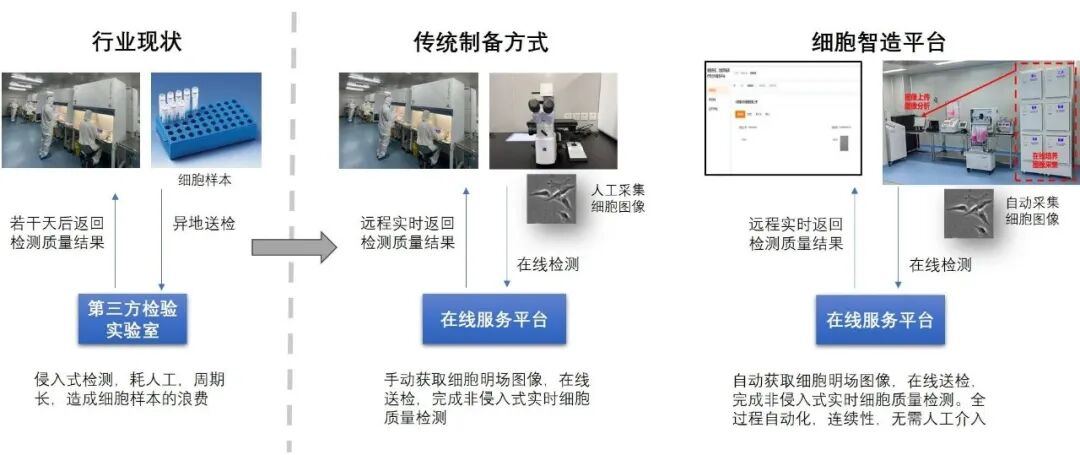
CellAuto provides a new online testing service for industry clients
The project’s core achievements address, and anticipate, several key tasks set out in the Opinions, highlighting CellAuto’s technical leadership, forward-looking application and industry-empowerment value in the field of AI + drug regulation.
I. Technical leadership: original AI models solve the core pain points of cell regulation, pioneering “non-invasive” monitoring and “function prediction”
Responding to the Opinions’ call to “raise the intelligence of review, inspection, testing and monitoring”, the project focuses on cell therapy — a high-risk frontier field — and breaks through the traditional reliance on invasive, destructive testing.
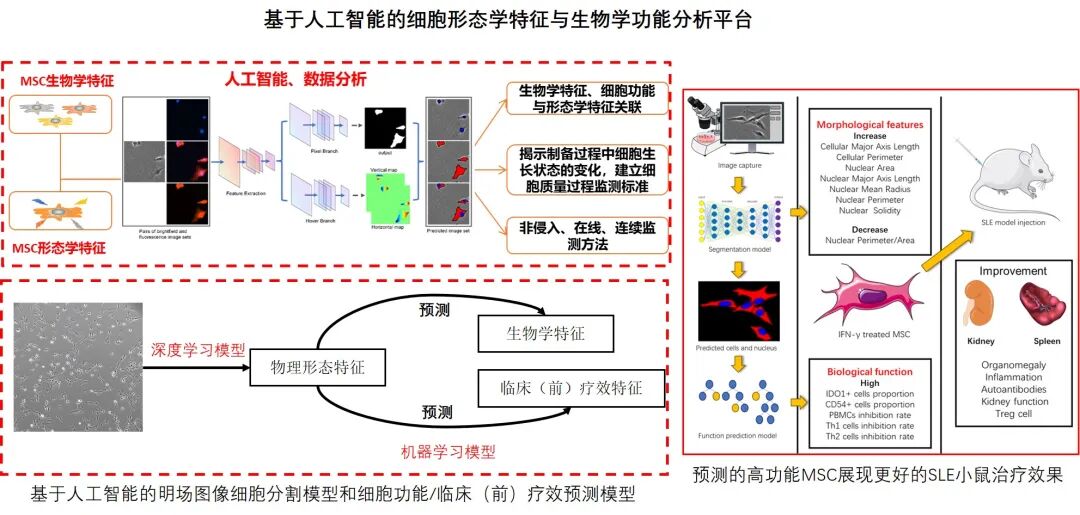
1. AI cell-image segmentation model — label-free, online intelligent inspection
Innovation: built on a deep-learning architecture, the AI model performs high-precision segmentation of bright-field cell images with over 90% accuracy, and can precisely extract 23 morphological features without fluorescent staining or other invasive steps.
Regulatory value: this provides regulators with a real-time, online, non-destructive in-process quality control (IPC) tool. In future it can be integrated seamlessly into the online monitoring systems of cell production lines, achieving the “real-time monitoring of full data” the Opinions advocate and replacing, in whole or in part, the traditional time-consuming off-line checks that consume samples.
2. AI cell-function prediction model — enabling risk-based intelligent review
Innovation: using machine-learning models, the project successfully established the link between cell morphological features and core biological functions (such as immunomodulatory capacity), and can precisely predict key quality attributes such as IDO1 expression, with prediction error below 10% and in some cases as low as 2%.
Regulatory value: this offers a successful example, in the cell field, of “developing risk-monitoring and assessment agents”. It makes it possible to predict functional potency through rapid, non-destructive morphological analysis before a cell product is released, providing an innovative technical path for the Opinions’ goals of “advance risk warning” and “product-risk-based review”.
II. Platform empowerment: a public technology-service platform advancing the coordinated digital development of regulation and industry
The project is not only a piece of technology development; it is a concrete embodiment of the Opinions’ vision of “promoting the coordinated digital development of regulation and industry”.
1. An open service platform that raises industry-wide quality control
The project built an online public-service platform able to serve more than 1,000 users with an annual testing capacity of 3,000 samples, providing efficient, authoritative third-party quality testing for research institutes, cell companies and medical institutions.
Regulatory value: the platform generates standardised, structured cell-quality data reports, helping to form a unified quality-evaluation benchmark across the industry and providing important data infrastructure and an industrial-coordination fulcrum for regulators building a “new pattern of intelligent drug-safety governance”.
2. Results translation and clinical validation, closing the reliability loop
High-quality cells screened by the AI models achieved a clear therapeutic effect in a systemic lupus erythematosus (SLE) mouse model, reducing the spleen index by 30.1% and raising the proportion of Treg cells by 74.01%.
Regulatory value: this pre-clinical validation strongly demonstrates the biological relevance and reliability of the AI prediction models, providing a solid scientific basis for using such AI tools as a supplement or alternative to production process control (PPC) or release standards for cell-therapy products.
III. System building: a complete IP and standards system
The project has applied for 7 patents, obtained 1 software copyright, formulated 2 enterprise standards and published 4 SCI papers.
Value: this builds a solid technical barrier and marks CellAuto’s evolution from a technology provider into an early explorer of industry standards and norms. These results contribute valuable “Shenzhen experience” and “enterprise solutions” toward future national technical guidelines, industry standards and data standards for intelligent testing and regulation in cell therapy.
In short, CellAuto’s non-invasive cell AI-monitoring platform is an early, vivid implementation of the national “AI + Drug Regulation” Opinions in the specific field of cell therapy. It achieves a paradigm shift from “invasive and destructive” to “non-destructive and online”, and from “after-the-fact testing” to “advance prediction”, while building a public technology platform that serves regulation and empowers industry — demonstrating CellAuto’s strength as a platform technology company whose core capability lies in the deep fusion of BT, IT and AT.