
CellAuto Series · Intelligent Adjusting System
AS015The hands that lift the cell factory.
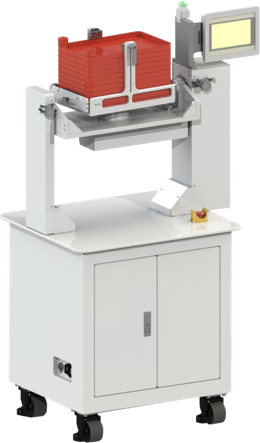
Filling a cell factory, draining it, turning it over and mixing it evenly are the operations an experienced technician does by feel. The AS015 reproduces them mechanically, for cell factories of different sizes, in a sequence that runs the same way every time.
Request a datasheet →See the full line
What it automates
Liquid filling
Media and reagents go into the cell factory in a controlled, repeatable movement, rather than being poured at whatever angle the operator happens to hold.
Liquid draining
Spent media and harvested suspension come out the same way, with the vessel held at the angle that empties it properly instead of leaving residue behind.
Flipping
The cell factory is turned over under machine control, which is the operation that is hardest on a technician's hands and easiest to do inconsistently.
Homogenisation
The contents are mixed evenly before the next step, so what is sampled and what is harvested are actually the same thing.
How it works
Two axes, one motion,and a path the machine remembers.
A cell factory is awkward to handle by design. It is heavy, it is sealed, and the way it is moved changes how evenly the cells sit on every layer. CellAuto built a new mechanism and control system for it rather than adapting an existing one.
Two rotating shafts
The two axes are controlled independently or together. A single-axis rotation suits one process, a combined movement suits another, and the system does both without being rebuilt.
A figure-eight path
Driving both axes together traces a compound motion shaped like a figure eight, which mixes the contents more evenly than rocking in a single plane can.
Programmed posture
Filling, draining, flipping and mixing run as a stored sequence of positions and orientations, so the handling is identical on the first batch of the week and the last.
The point of automating this step is not speed, it is consistency. Mixing uniformity and batch-to-batch repeatability both come from the vessel being moved the same way every time, which is the one thing manual handling cannot promise.
Specification
Dimensions, weight and rated power are taken from the CellAuto production line configuration sheet. Final configuration is confirmed during project validation.
In a production line
What ten thousand vials a yearactually looks like.
A real CellAuto line configuration. Two AS015 units handle the cell factories moving through thirty-six culture matrices, on a culture time of seven to nine days per batch.
Worked from 6.60 × 10⁷ cells per vial, a new batch started every two days and thirty-six culture matrices. At five hundred million cells per ten-layer factory the line reaches roughly 10,400 vials a year, and at seven hundred million it reaches 14,600. Your own configuration is sized against your cell type, batch size and facility.
Where it sits in the line
The AS015 is not a phase of its own. It works at the culture stage, handling the cell factories that move between the dispensing system and the processing system, alongside the WAVE010 Bioreactor, and the Cell Full Lifecycle Management Platform records every phase.
The rest of theCellAuto Series.
Talk to an engineerabout your process.
Tell us the cell type, the batch size and the facility you have, and we will tell you what the line looks like for you.