
CellAuto Series · Intelligent Dispensing System
IDS015Every reagent arrives through a closed line.
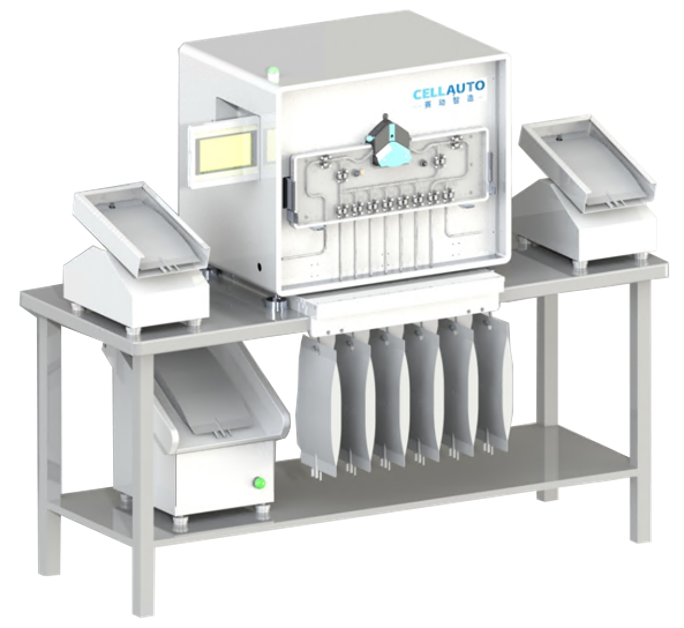
The IDS015 docks to cell factories and to the automated processing systems through a fully closed tubing connection, and runs the whole reagent transfer workflow, seeding, enzymatic digestion and harvesting, to a predefined recipe.
Request a datasheet →See the full line
Key features
Built for a Grade D cleanroom
Designed for automated manufacturing lines running in Grade D environments, so it drops into a compliant cell therapy workflow without raising the facility requirement.
Closed and contamination resistant
A closed tubing interface connects cell factories to the automated processing systems, which keeps contamination risk low and the process aseptic from the start.
Runs standalone or in line
Works on its own or integrated with the line, and handles multiple liquid sources and bag configurations, so one unit covers a wide range of reagent preparation work.
Intelligent process management
Material transfer and process execution follow predefined workflows, which makes reagent preparation efficient, accurate and traceable rather than operator dependent.
How it works
The reagents come to the cells,not the cells to the bench.
Reagent handling is where an open process usually loses its sterility, because every bottle opened and every pipette used is another chance to contaminate a batch. The IDS015 removes the open step entirely.
Configure the liquids
Multiple liquid sources and bag configurations are combined freely for the recipe in hand, whether that is a single customised batch or a scheduled production run.
Dock, do not pour
Closed tubing connects the unit to the cell factory and to the automated processing systems. The reagent path is sealed end to end, so a Grade D room is enough.
Run the recipe
Seeding, enzymatic digestion and harvesting transfers execute to predefined parameters, while materials and process steps are managed and recorded as the run happens.
Because the transfers are driven by a recipe rather than by hand, the same volumes arrive at the same moments on every batch, and the record of what went in is written while it is going in, not reconstructed afterwards.
Specification
Dimensions, weight and rated power are taken from the CellAuto production line configuration sheet. Final configuration is confirmed during project validation.
In a production line
What ten thousand vials a yearactually looks like.
A real CellAuto line configuration. Two IDS015 units feed it, keeping thirty-six culture matrices supplied alongside the processing, posture adjustment and filling systems, with a culture time of seven to nine days per batch.
Worked from 6.60 × 10⁷ cells per vial, a new batch started every two days and thirty-six culture matrices. At five hundred million cells per ten-layer factory the line reaches roughly 10,400 vials a year, and at seven hundred million it reaches 14,600. Your own configuration is sized against your cell type, batch size and facility.
Where it sits in the line
The AS015 Automatic Posture Adjustment System and the WAVE010 Bioreactor sit alongside the culture stage, and the Cell Full Lifecycle Management Platform records every phase.
The rest of theCellAuto Series.
Talk to an engineerabout your process.
Tell us the cell type, the batch size and the facility you have, and we will tell you what the line looks like for you.